SEO metrics that matter (and the ones that don't)
The search metrics worth tracking on a small or mid-sized site, and the ones to stop reporting.
Impressions, clicks and click-through rate
Open the Performance report in Search Console and the first two numbers are impressions and clicks. An impression is Google showing a link to your site on a results page. A click is someone choosing it. Google counts an impression whether or not the person scrolled far enough to see the link, unless it sits inside something that has to be expanded, like a carousel, in which case it counts only once opened.
Impressions measure visibility. Clicks measure whether you were picked. Divide clicks by impressions and you get click-through rate, which measures how appealing your result looks next to the others on the page. The three move independently. Impressions can double while clicks stay flat, which usually means you have started appearing low on the page for searches you have not earned yet.
Click-through rate at a given position has been falling. One 2025 study built on Search Console data for about 74,000 keywords ranking in the top ten put the first result at 19 clicks per 100 impressions, down from 28 the year before, as AI answers and ads pushed the plain links further down the page. Other studies disagree with each other by a factor of several, so do not chase a published benchmark. Compare your own click-through rate page by page, and look for pages whose rate sits far below their neighbours at a similar position. Those are the titles and descriptions to rewrite.
What average position measures
Position is the slot your result occupied on the page, and every block on the page takes one slot, so an ad, a map pack and an AI answer each use up a position before the first ordinary link. When your site appears more than once for a query, Google counts only the highest slot. Average position is that number averaged across every search the page appeared for.
That last part is why the metric misleads. Suppose a page sits at position three for the ten searches that matter to you, and then starts appearing at position forty for two hundred new, loosely related searches. Its clicks go up while its average position collapses into the thirties, and nothing got worse. Google's own documentation calls position "a complex metric that can be misleading" and warns against reading it as a single ranking.
So never read average position on its own. Filter the report to the handful of queries you care about and track position for those. For everything else, impressions and clicks are the better guide.
How many pages are indexed
Nothing ranks until it is indexed, so the Pages report in Search Console is the second thing to check. It splits every URL Google knows about into indexed and not indexed, with a reason for each of the latter: blocked by robots.txt, marked noindex, a duplicate of another page, a server error, or the two vaguest, "crawled, currently not indexed" and "discovered, currently not indexed".
The metric is the count of indexed pages, and whether it includes the pages you care about. Filter the report to the pages in your sitemap and the not-indexed list becomes short and readable. Google's own description of a healthy report is an indexed count that grows with the site, every important page in green, and a not-indexed list where every entry has a reason you recognise. Duplicates and tag archives sitting unindexed are normal. A product page or a new post stuck under "discovered, currently not indexed" for a month is the thing to act on.
Organic visits in your analytics tool
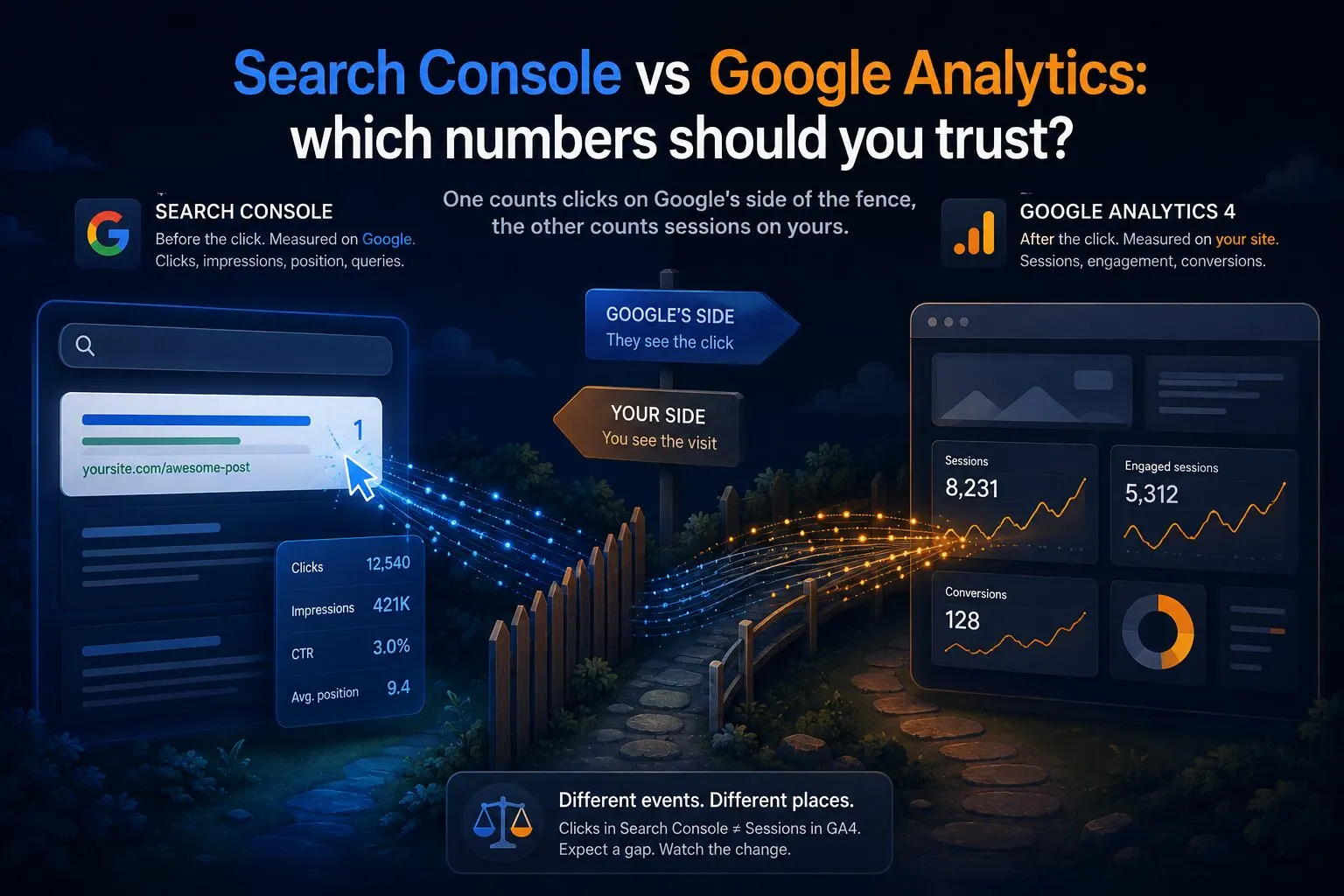
Search Console stops at the click. Your web analytics tool picks up from the moment the page loads, and its organic search channel is the count of visits that arrived from a search engine. What is organic traffic covers what counts and what gets mislabelled. This is the number most people mean when they say "our SEO traffic".
It will not match Search Console clicks. Ad blockers, consent banners and the way each tool counts a visit all push the analytics figure below the click count, and Search Console vs Google Analytics walks through each cause. Use the analytics number for trends and for what happens after the click, and do not try to reconcile the two.
Two cuts of organic visits are worth more than the total. Organic visits by landing page shows which pages actually earn search traffic, and it is usually a short list. Organic visits to pages published this quarter, against everything older, tells you whether new content is doing anything yet.
Organic conversions and revenue
This is the metric that decides whether SEO is working. A conversion is whatever you set up your site to produce: a signup, a purchase, a demo request, a phone call. Organic conversions are the ones that came from a search visit. Organic conversion rate is those conversions divided by organic visits. How to track website conversions covers setting up the goals themselves.
Report this one above every number from Search Console. Impressions can rise on searches nobody buys from. Traffic can rise on a post that brings readers who leave in ten seconds. Conversions from search are the thing you can show a co-founder or a client. If traffic doubles and conversions stay flat, the new visitors came for something you do not sell.
Most web analytics tools can split conversions by traffic source. Bigdelta, for example, attributes every visit to search, social, referral, email or direct, and can attribute subscription revenue back to those channels and landing pages. For a store the equivalent number is revenue from organic visits, and ecommerce analytics covers how to get it.
Core Web Vitals
Core Web Vitals are Google's three measurements of page speed and stability: how long the largest thing on the page takes to appear (Largest Contentful Paint), how quickly the page responds when someone taps or clicks (Interaction to Next Paint), and how much the layout jumps around while loading (Cumulative Layout Shift). Google's published thresholds for "good" are 2.5 seconds, 200 milliseconds and a shift score of 0.1. Each is measured at the point that three out of four real visits meet, so a minority of slow visits still counts, and mobile and desktop are scored separately.
The Search Console report for this uses real visitor data collected by Chrome and sorts your pages into good, needs improvement and poor. It shows nothing for pages without enough visitors, so a small site may see an empty report, and that is not a fault. A group's status is its worst metric, so one bad number turns the whole group amber.
How much this matters for ranking is easy to overstate. Google says its ranking systems use Core Web Vitals, and in the same document says it "always seeks to show the most relevant content, even if the page experience is sub-par". Treat the report as a monthly check for pages that have slipped into poor, and fix those. Do not spend a quarter turning good into slightly better good.
Referring domains
A referring domain is a website that links to yours at least once. The count of them is the closest thing to a measurable version of authority, and it is the raw material behind most third-party "authority" scores. The Links report in Search Console lists your top linking sites and most linked pages, but describes itself as a sample, so treat it as an indicator. A backlink tool will give a fuller count.
Track the number over time and read the list once a month, looking for new domains that are real sites in your field and links pointing at the pages you want to rank. A hundred links from one directory count as one domain. Ten links from ten relevant blogs are worth more than that.
Metrics to stop reporting
Four numbers show up on most SEO reports and say almost nothing.
- Domain authority, domain rating and the other authority scores. These are invented by SEO tool vendors, each with its own formula. A Google search analyst put it plainly in 2020: Google does not use domain authority "at all" in crawling, indexing or ranking. The score can be a rough shorthand for how many good links a site has, and it is not a goal.
- Total keywords ranked. Rank-tracking tools count every query a site appears for, including position ninety for a search nobody makes. The number rises whenever you publish anything.
- Rankings for vanity terms. Position for the broad head term in your category is fun to watch and usually unwinnable for a small site. The searches that convert are longer and more specific, and Search Console already shows you which ones.
- Bounce rate as an SEO signal. Google's search team has said since 2015 that it does not use analytics bounce rate in ranking, and repeated it in 2022. Bounce rate is still a useful page metric, and what a good bounce rate looks like explains how to read it. It is just not an SEO metric.
How often to check each
Google's own advice for Search Console is that there is no need to sign in every day, because it emails you when it finds a problem, and that once a month or after a site change is enough. That matches how slowly these numbers move. A weekly glance at organic visits and organic conversions in your analytics tool catches a tracking break or a sudden drop. Everything in Search Console can be a monthly review, compared with the same month a year ago, because search traffic is seasonal and last month is often the wrong baseline. Search Console keeps sixteen months of history, just enough for that comparison.
A one-page SEO report for a small site has about eight lines: impressions, clicks, click-through rate, indexed pages, organic visits, organic conversions, organic conversion rate and referring domains, each against the same period last year. Add Core Web Vitals as one more line, the number of pages rated poor. How to build a web analytics report covers the format: one number per line, and a sentence saying what you will do about it.
What to do when a metric moves
Every one of these metrics is a prompt to look closer. Impressions up and clicks flat means new low-position queries, so check which ones and whether the pages deserve better titles. Clicks down with impressions steady means the results page changed around you, often an AI answer or a new ad block above your link. Indexed pages down is a technical problem before it is anything else. Conversions down while visits hold means the visitors changed, so look at landing pages and queries.
A sharp drop across the board has its own diagnosis in why did my traffic drop, and a sudden rise its own checks in why did my website traffic spike. For everything slower, pick the two or three pages that earn most of your organic conversions and watch their numbers every month. On a small site most of the value of SEO sits in a handful of pages, and the metrics matter only for what they say about those.