Heatmaps for SEO: what behaviour data can and can't do for rankings
Google never sees your heatmap. What click and scroll maps are actually worth in SEO work: diagnosing pages that rank but produce nothing, testing content length against real readers, and finding the internal links nobody clicks.

First, the honest part: Google doesn't see your heatmap
Heatmap data lives in your analytics tool. Google's ranking systems do not read it, and Google's own page experience documentation lists what it does look at: Core Web Vitals, HTTPS, mobile usability, intrusive interstitials. Scroll depth, time on page and heatmap engagement are not on the list, and claims that "dwell time" is a confirmed ranking factor have never been backed by Google's documentation.
So a heatmap is not a ranking lever you pull. It is a diagnostic for the thing rankings are ultimately paid to produce: a page that satisfies the visitor the query sent. Everything below is that indirect route, using behaviour to make pages better, and letting better pages earn what they earn.
The rank-but-nothing-happens diagnosis
The most useful SEO heatmap workflow starts in Search Console. GSC tells you a page ranks and gets clicked, your SEO metrics confirm traffic is arriving, and the conversions or signups the page exists for still do not show up. The numbers stop there. They cannot say what those search visitors did between arriving and leaving.
The heatmap can. Filter the map to organic visitors, most tools can, Bigdelta for instance splits any heatmap by traffic source, and read it against the query the page ranks for. The common findings are mundane and fixable: the content that answers the query sits below where searchers stop scrolling, the call to action is outside the hot zone entirely, or the clicks pile onto a navigation link that leads visitors away before they reach the point. None of that is visible in a rankings report, and all of it wastes rankings you already earned.
Scroll maps against your content decisions
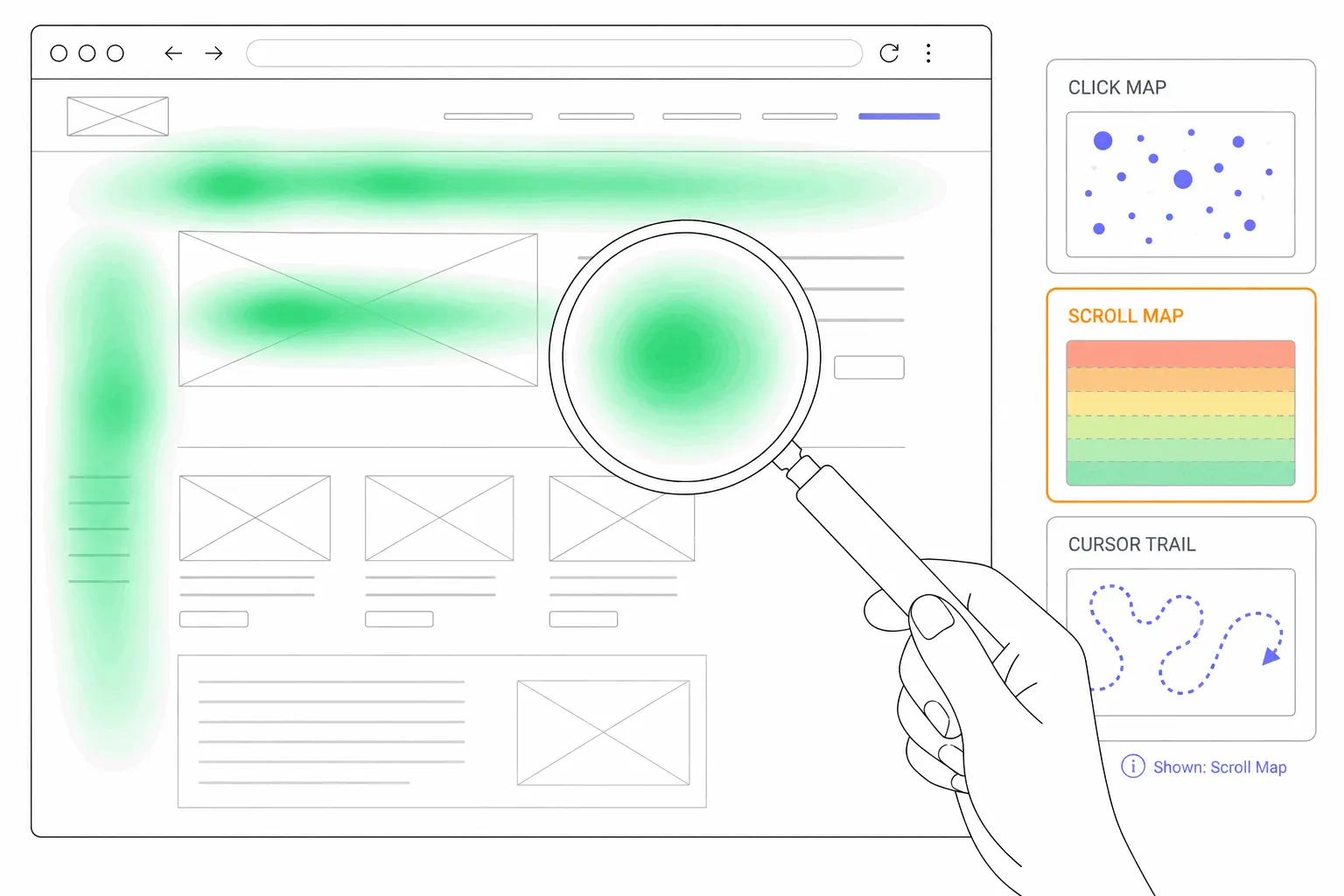
SEO produces strong opinions about content length, and scroll maps are the cheapest way to test them against your own readers. The map shows where attention actually collapses on a page: sometimes at a section heading that promises the article is over, sometimes at a wall of text, sometimes at a full-width image that looks like a page footer, the false floor pattern where readers think the page ended and leave.
That reading changes SEO decisions directly. A 3,000-word guide where the map goes cold at 40 percent is not a thin-content problem, it is an ordering problem: the material below the cold line might be better moved up, cut, or split into its own page. And a page where readers routinely reach the end is earning its length, whatever a word-count rule says. Scroll depth tracking covers the measurement side of this in detail.
Click maps and internal linking
Internal links are an SEO instrument, and click maps are the only report that shows whether anyone uses them. The pattern worth hunting is the important link nobody clicks: the pillar page buried in a sidebar the map shows to be invisible, or the related-article links below the point where the scroll map says readers stop.
The fix is placement, not more links. Links inside the running text of the hot zone get clicked, and the map shows precisely where that zone ends on each page. When a page you care about is linked only from cold regions of other pages, the click map has found you an internal-linking task more concrete than anything a site crawler will suggest.
After a rankings drop
A rankings drop starts arguments about causes, and behaviour data settles one of them early. Before rewriting a page that slipped, look at what current visitors do on it. If the map shows people arriving, reading and finishing, the page is probably not the problem, and the cause is more likely elsewhere: a tracking or seasonality issue, lost links, or a competitor simply outranking you. If the map shows arrivals bouncing off the top section, the rewrite has a specific target instead of a vague mandate to improve things.
The discipline matters here more than anywhere: a map needs a few hundred visits before its patterns mean anything, and reading a heatmap properly is its own skill. A page that just lost rankings is also losing the traffic that feeds its map, so read the pre-drop period where the data is dense.
What heatmaps can't do for SEO
Being clear about the limits keeps the tool credible. A heatmap cannot tell you what to rank for, that is keyword work. It cannot see why you rank where you do, that is authority and relevance, largely links and content. It cannot fix crawling or indexing, and it will not move Core Web Vitals, which are measured by real-user performance data, not click positions. If those are the open questions, heatmaps are the wrong tab.
Where they fit is the last metre of SEO: the visit itself. Rankings and clicks are only inputs, and the page's behaviour data is the closest thing you have to watching whether the search visitor got what the query promised. Used that way, on ranking pages, with enough traffic and a specific question, a website heatmap earns its place in an SEO toolkit without a single overclaim about ranking factors.