Average scroll depth benchmarks: what the real studies measured
The most-quoted scroll benchmark is a units error, and its companion has no source. What Chartbeat, NN/g, Contentsquare and ClickTale actually measured, why percent-of-page averages blend into noise, and the per-page reading that answers the real question.

Four real studies, four different quantities
Chartbeat, 2013: pixel reach on article pages. Analysing 25 million reading sessions, Chartbeat found peak viewership just above the fold and reported that half of readers reached around the 1,500-pixel mark on a typical article, findings written up at the time in Slate. The companion dataset, two billion pageviews presented by Chartbeat's CEO in TIME, added that 55 percent of pageviews got under fifteen seconds of attention, while two-thirds of the attention on a typical media page is spent below the fold. Pixel depths, article pages, a media-heavy sample, twelve years ago.
Nielsen Norman Group, 2018: attention, not distance. The eyetracking study behind the misquoted figure, Scrolling and Attention, measured where people look: 57 percent of viewing time above the fold, 74 percent within the first two screenfuls, down from 80 percent above the fold in their 2010 study. People scroll further than they used to. Their attention still concentrates at the top. Neither number says how far down the page scrolling stops.
Contentsquare, 2026: the one modern defined average. The 2026 Digital Experience Benchmark (99 billion sessions, 6,500 mostly enterprise sites) publishes a scroll rate with a stated definition, the furthest pixel displayed as a share of page height: 50.5 percent on desktop and 45.2 percent on mobile, down about 2 percent year over year. If you need one citable "average scroll depth," this is the only current one measured as percent of page with the definition in writing, and it says people see about half the page.
ClickTale, 2007: the historical anchor. The earliest large study, around 120,000 pageviews, found 76 percent of visitors scrolled at all and 22 percent reached the bottom, and observed that people scroll in proportion to the page rather than to a fixed pixel depth, a finding that quietly contradicts reading Chartbeat's pixel numbers as universal.
Why the average resists benchmarking
Percent-of-page depends on the page. Fifty percent of a 2,000-pixel landing page and 50 percent of a 12,000-pixel guide are entirely different behaviours wearing the same number, so any cross-site average blends page lengths into noise. Making pages shorter mechanically raises the percentage while showing visitors less, which is how a metric becomes a target and stops meaning anything.
The tools do not agree on what to record either. GA4's enhanced measurement fires exactly one scroll event at 90 percent depth, once per page per session, not adjustable in the interface, so GA4's "scroll rate" is really a page-completion rate. Custom setups go through Tag Manager's scroll depth trigger, whose own documentation notes that a threshold visible in the viewport at load fires without the user scrolling at all, the false floor that inflates shallow thresholds on short pages. Heatmap tools record the full depth curve instead. Three instruments, three different numbers from the same visitors.
What to use instead of an average
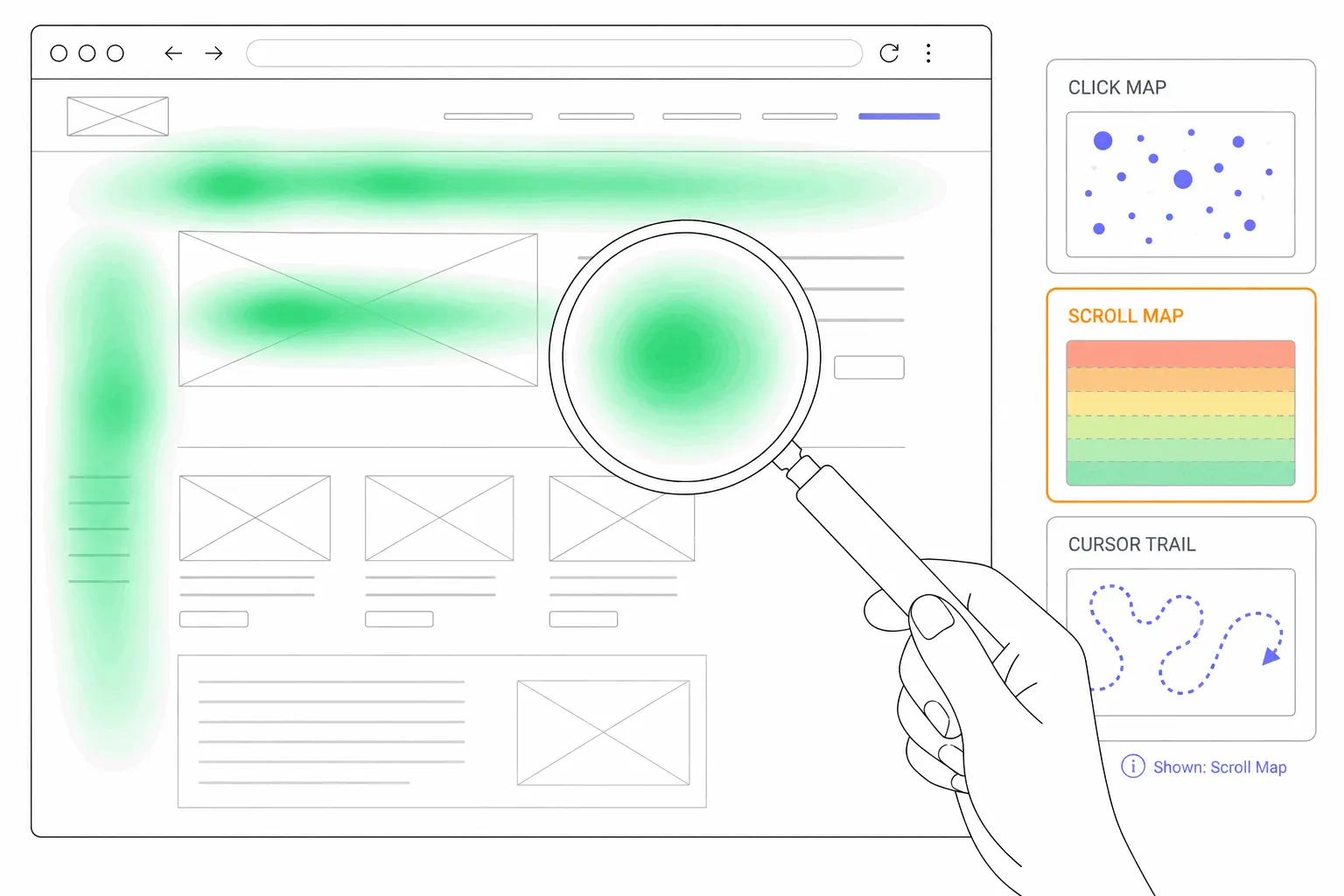
Per-page curves beat site averages. The useful scroll question is never "what is my average" but "where on this page does attention collapse," which is a scroll map reading: the drop-off cliff at a false floor, the section nobody reaches, the patterns the examples gallery shows. A page's own curve, compared before and after a change, answers the question the average dodges.
If you want one trackable number, GA4's 90 percent completion rate is honest precisely because it is blunt: the share of views where someone effectively reached the end. Trend it per template, articles against articles, landing pages against landing pages, rather than site-wide, and read it next to time-based metrics, since the Chartbeat data's most durable lesson is that scrolling and attention are different things: pages get scrolled without being read, and read without being finished.