Is Google Analytics free?
Yes - genuinely, with no trial expiring behind your back. But the free tier has walls, the paid tier costs more than most companies' analytics budgets, and some of what free costs you isn't on any invoice. The full picture.

The short answer
Google Analytics 4 is free. Not freemium-with-a-catch, not a trial that converts: the standard tier costs nothing, indefinitely, at any traffic volume, and it's the same product running on millions of sites. Google has never charged for the standard product in twenty years, and there's no sign that changes.
So why does the question get asked 900-odd times a month? Because "free" hides three separate topics people are actually asking about: where the free tier's limits sit, what the mysterious paid version costs, and what using a free Google product costs in ways that aren't money. All three have concrete answers, and knowing them is the difference between choosing GA4 and defaulting to it.
What the free tier actually includes
The free tier is genuinely generous where it counts. Data collection itself is effectively unconstrained for normal sites - GA4 standard doesn't meter pageviews the way paid analytics tools do, which is precisely why a tool this heavy became the default for the whole internet. You get the full reporting interface, the Explore workbench, audiences, the ads integrations, the Search Console link, and a BigQuery export.
The structural allowances are wide too: an account can hold up to 2,000 properties, an event carries up to 25 parameters, a property can define 50 custom dimensions. Small sites never touch any of these. The built-in reports run unsampled, meaning the numbers in the standard screens are computed from all your data, not an extract. For "free", that's a lot of product - which is the honest half of the story.
Worth stating because people ask: there's no volume tripwire where a growing site suddenly owes money. A blog at ten thousand pageviews and a store at ten million run the same free tier. That's unusual - nearly every commercial analytics tool prices by traffic - and it's the single strongest argument for GA4 that its critics have to concede.
Where the walls are
The free tier's limits cluster around history, scale and support. History: event-level data retention caps at 14 months, and the default is two - so Explorations, audiences built on past behavior, and any year-over-two-years analysis run out of road unless you export your own archive. The standard reports reach further back, which softens this for casual use and surprises people the first time an Exploration comes up empty.
Scale: Explorations sample above 10 million events per query - irrelevant to small sites, real for big ones, and the reason a busy property's ad-hoc analyses come back as estimates. The BigQuery daily export caps at one million events a day on the free tier (the streaming export is uncapped, but you're paying Google Cloud for it). And thresholding withholds small-segment data whenever Google Signals is in play, whatever your size.
Support: there isn't any. No SLA, no one to call when data goes strange, no guarantee about processing times. Free means the community forum and your own debugging. For a personal site that's fine. For a business that books revenue against these numbers, it's a real line item hiding at zero dollars.
Google Analytics 360: the paid version almost nobody needs
The paid tier, GA4 360, exists for enterprises and is priced like it. Google doesn't publish the price - it's a contact-sales product, usually bought through a reseller - but the commonly cited entry point runs around $50,000 a year, scaling with volume. What the money buys is documented: retention up to 50 months, sampling thresholds raised a hundredfold, unsampled exploration exports, an uncapped daily BigQuery export, SLAs on data processing, and enterprise support.
Read that list again and notice what it is: the same product with the walls moved back. Nothing in 360 changes what GA4 fundamentally does - it removes the free tier's constraints for organizations big enough to hit them daily. If you're asking whether you need 360, you don't. The companies that need it have analysts who already know.
The differences that actually get bought, free tier against 360:
- Event-level retention: 14 months maximum, against up to 50 months.
- Exploration sampling: kicks in at 10 million events per query, against 1 billion.
- BigQuery daily export: capped at 1 million events a day, against uncapped.
- Unsampled exploration results: not available, against available on request.
- Guarantees: none, against SLAs on collection and processing, with support attached.
Do you pay with your data?
The "if it's free, you're the product" reflex deserves a precise answer rather than a shrug. GA4 has data-sharing settings you control, covering things like whether your analytics data helps improve Google's products and whether Google's support can access your account - and the measurement data is governed by contract terms, not quietly absorbed into Google's ad machine. The claim that Google reads your analytics to bid against you is folklore, not documentation.
The subtler truth: Google's incentive for two decades of free analytics is the ecosystem, not your rows. GA4 is the measurement layer that makes Google Ads spending legible, which keeps advertisers spending. You're not the product so much as the plumbing. Whether that bothers you is a values question, not a technical one - the technical settings, at least, are yours to set, and worth five minutes on any new property.
The costs that aren't on an invoice
Three costs of free GA4 are real and routinely uncounted. Time first: GA4 is famously effortful to learn, and hours spent deciphering reports are hours - at whatever you bill - spent on a free product. Plenty of small businesses have paid consultants to configure their free analytics, which is a price tag with extra steps.
Consent second: for EU traffic, GA4's cookies generally mean a consent banner, and every visitor who declines is invisible to your reports. The measurement you get is a floor, and maintaining the consent stack properly is its own small workload. Jurisdictions vary and this isn't legal advice - but the banner is part of GA4's real cost of ownership in Europe, and vendors selling alternatives bring it up for a reason.
Complexity third, and most quietly: an analytics tool nobody opens produces nothing, free or not. If GA4's interface means your traffic gets checked quarterly instead of weekly, the free tool is underperforming a paid one that would actually get used. Tools are only cheap when they work for you.
The Universal Analytics lesson
One piece of history belongs in any decision about depending on free GA4. Universal Analytics - the previous Google Analytics, free in exactly the same way - was retired in 2023, and within about a year its stored history became inaccessible too. Sites that hadn't exported were left pointing at a decade of traffic data that no longer existed anywhere. Nobody was owed anything: free products carry no promises, and Google had announced the timeline repeatedly. It still caught an enormous number of site owners flat.
The lesson isn't that GA4 will vanish - it's that a free tool's continuity is Google's decision, not yours, and the cheap hedge is the same one the retention limit already suggests: a monthly export of the totals you'd mourn, kept in a spreadsheet you own. Ten minutes a quarter buys you indifference to product strategy, which is the best relationship to have with any free dependency.
The free alternatives, honestly compared
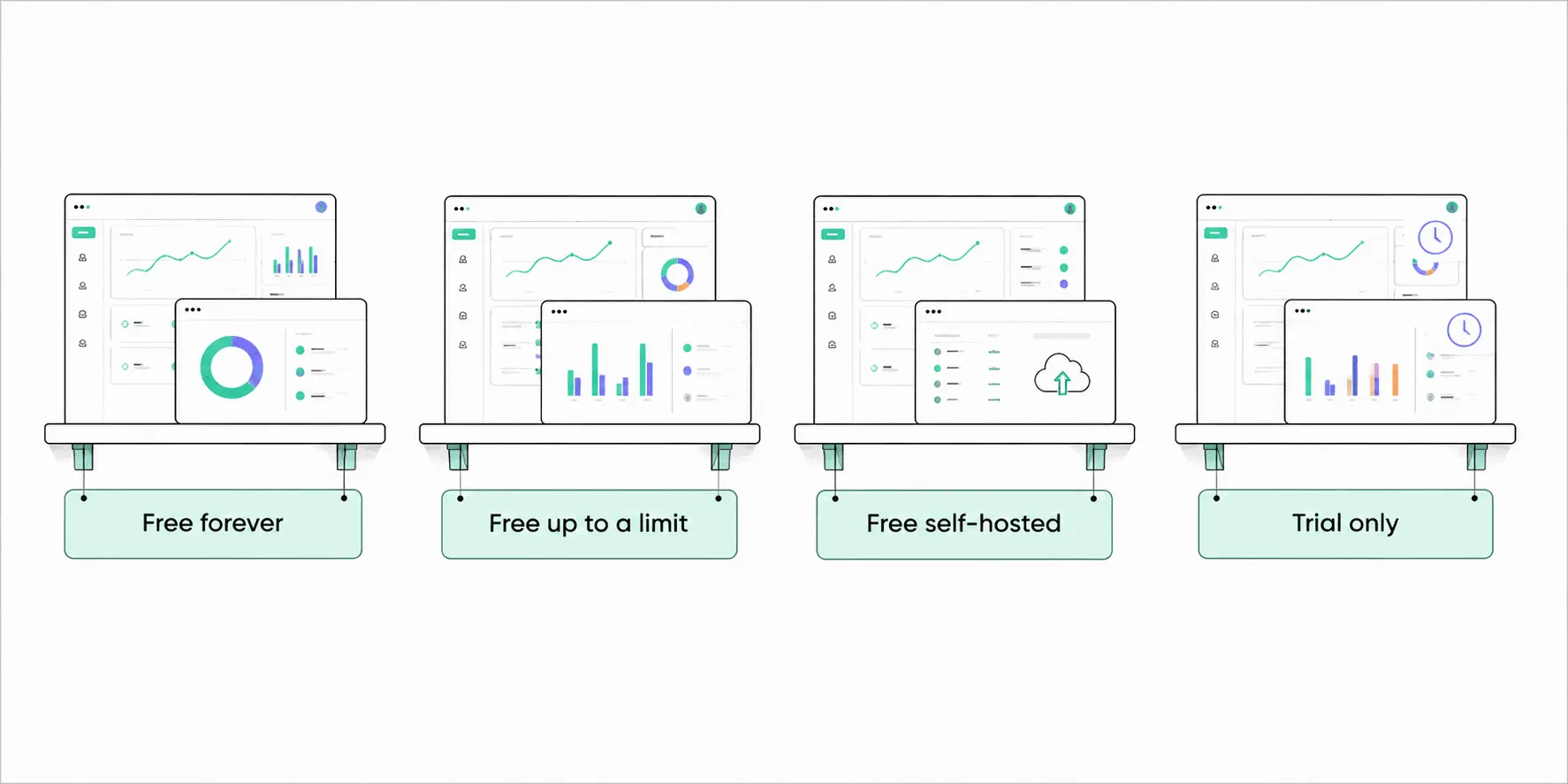
GA4 is no longer the only serious free option, but the field is narrower than roundup posts imply - we verified the free tiers recently and several famous ones have quietly gone paid. The current honest map: Plausible's cloud version dropped its free tier (self-hosting its community edition remains free, for the technically willing), Fathom is trial-only, Clicky's free tier covers one site at 3,000 daily pageviews, Umami keeps a free hobby tier. Bigdelta's free tier covers sites up to 100,000 pageviews a month, with the replays and funnels included.
The pattern across the category: lightweight tools are free at small scale and paid at real scale, while GA4 is free at every scale and costs you in the other currencies above. Which trade is right depends entirely on whether the limits you'd hit are the ones that matter to you.
The questions behind the question
Will Google start charging? Nothing suggests it. The free tier has survived two decades and a full product rewrite, and the strategic logic - measurement that keeps the ads ecosystem legible - hasn't changed. The realistic risk isn't a price tag appearing; it's the product continuing to change shape under you, the way Universal Analytics was retired with its history effectively stranded. Your own exported archive is the insurance, and it costs a spreadsheet.
What happens if I hit a limit? Nothing dramatic. GA4 doesn't stop collecting or lock your account - explorations sample, old event data ages out, the export caps. Degradation, not shutoff. The limits are walls you lean on, not tripwires.
Is there a free trial of 360? Not in the self-serve sense - 360 is sold through sales conversations and resellers, which is itself the clearest signal of who it's for. If your organization is the right size for it, the evaluation happens with account teams, not a credit card form.
And the one nobody asks out loud: is free GA4 good? Genuinely, yes - it's an enterprise-grade product at zero dollars, which is why it dominates. The catch was never quality. It's fit: heavy machinery is only a bargain if you needed heavy machinery.
So when is free GA4 the right call?
Clear cases for it: you run Google Ads (the integration is the whole point), you need the BigQuery export, your traffic is large enough that per-pageview pricing elsewhere stings, or your questions genuinely need the Explore workbench's depth. In those situations GA4's free tier is an extraordinary deal and the learning curve is the fair price.
Clear cases against: your questions fit on one screen - visitors, sources, pages, conversions - and you'd trade Explore for never reading a GA4 tutorial again. That's most small sites, and it's the population the lighter alternatives were built for. Running both is also legitimate and common: GA4 for the plumbing, something readable for the humans.
The practical takeaway
Google Analytics is free, the paid version is an enterprise product with an enterprise price, and the free tier's walls - 14-month retention, exploration sampling, a capped export, no support - sit far enough out that most sites never touch them. The costs that should actually drive your decision are the off-invoice ones: the learning curve, the consent overhead, and the risk of owning analytics nobody reads. Price the tool in hours and attention rather than dollars, and the right answer for your site usually gets obvious.