The best web analytics tools in 2026 (and how to actually choose)
Six tools that answer 'who visits my site and what do they do' — from GA4 to the lightweight cookieless generation. What each one is actually good at, where each one stops, and a decision rule that's shorter than any feature table.
What 'best' depends on
Every list like this one secretly answers a different question: best for whom? A hobby blog, a DTC store and a B2B SaaS site all need web analytics, and they'd each rank the same six tools differently. So before the tools, the four things that actually separate them.
Whether you can read it. The most common analytics failure isn't missing data — it's a dashboard nobody opens. A tool you check weekly beats a more powerful one you abandoned in February. This single criterion explains most of the migration away from Google Analytics.
What it costs. The spread runs from permanently free to hundreds a month, and free has two different meanings: free because Google monetizes the ecosystem around it, or free up to a traffic ceiling.
How it handles privacy. Cookie-based tools generally need consent banners in the EU; cookieless ones generally don't for the analytics itself. This decides both your legal paperwork and your data quality, since every consent banner shrinks the share of traffic you can see.
What it connects to. Pageview counting is a commodity now. The differences live at the edges: does the tool see revenue, sessions as recordings, the user after signup? If your site exists to make money, whether the analytics can see the money is worth more than any interface polish.
Google Analytics 4 — the default, for a reason and at a price
Free at any traffic volume, event-based, and connected to the advertising ecosystem your campaigns probably run in. If you spend on Google Ads, GA4's integration is the argument for it — imported conversions, audience sharing, the loop closed in one place.
The price is the learning curve. GA4 assumes you know what you're looking for, and most site owners never get comfortable enough to answer basic questions without a search for 'how to find X in GA4.' It also sits squarely in the cookie-consent world, so EU traffic arrives shrunk by however many visitors decline the banner. The full comparison against the lightweight generation is in the Google Analytics alternative guide — the short version is that GA4 is the right default when ads integration matters and the wrong one when reading the dashboard is the bottleneck.
Plausible — the open-source lightweight
One script, one page of numbers, cookieless by design, EU-hosted, with the code open source — you can pay for the hosted service or run the community edition on your own server. Plausible made its name as the anti-GA4: everything on one screen, no consent banner needed for the analytics, no data leaving Europe.
The trade is depth. It counts traffic well and deliberately stops there — no session recordings, no user profiles, no revenue attached to sources beyond basic goal values. For a content site or a portfolio that wants honest numbers without the surveillance aftertaste, that's the point, not a gap.
Fathom — the same philosophy, closed source
Fathom occupies the same square as Plausible: cookieless, banner-free for analytics, a dashboard readable in one glance, paid subscription. The differences are at the margins — closed source, North American company, slightly different feature edges — so the choice between the two usually comes down to taste and pricing at your traffic level.
Matomo — GA depth, your server
Matomo is the option for teams that want GA-class features and full ownership of the data. Self-hosted it's free and the numbers live on your own infrastructure — which is why it shows up in government and healthcare — or you can pay for their cloud. Feature-wise it's the deepest tool on this list after GA4: heatmaps, funnels, even replays, mostly as paid add-ons.
The cost is operational. Self-hosting a busy analytics install is real server work, and the interface, while friendlier than GA4, is a generation older than the lightweight tools. Pick it when data sovereignty is a requirement rather than a preference.
Clicky — the real-time veteran
Clicky has been counting visitors since 2006 and it shows in both directions: the real-time view is still one of the best — individual visitors on the site right now, with their path unfolding live — and the interface looks its age. There's a free tier for small sites. It earns its place for the live view alone; as a daily dashboard it's the acquired taste on this list.
Bigdelta — analytics, session replays and heatmaps in one
Bigdelta bundles what usually takes two or three subscriptions: web analytics on a dashboard readable without training, session replays for watching what a chart can't explain, and heatmaps showing where visitors click and scroll. The Forever Free plan covers up to 100K pageviews a month, and a cookieless option keeps the analytics out of the consent-banner conversation.
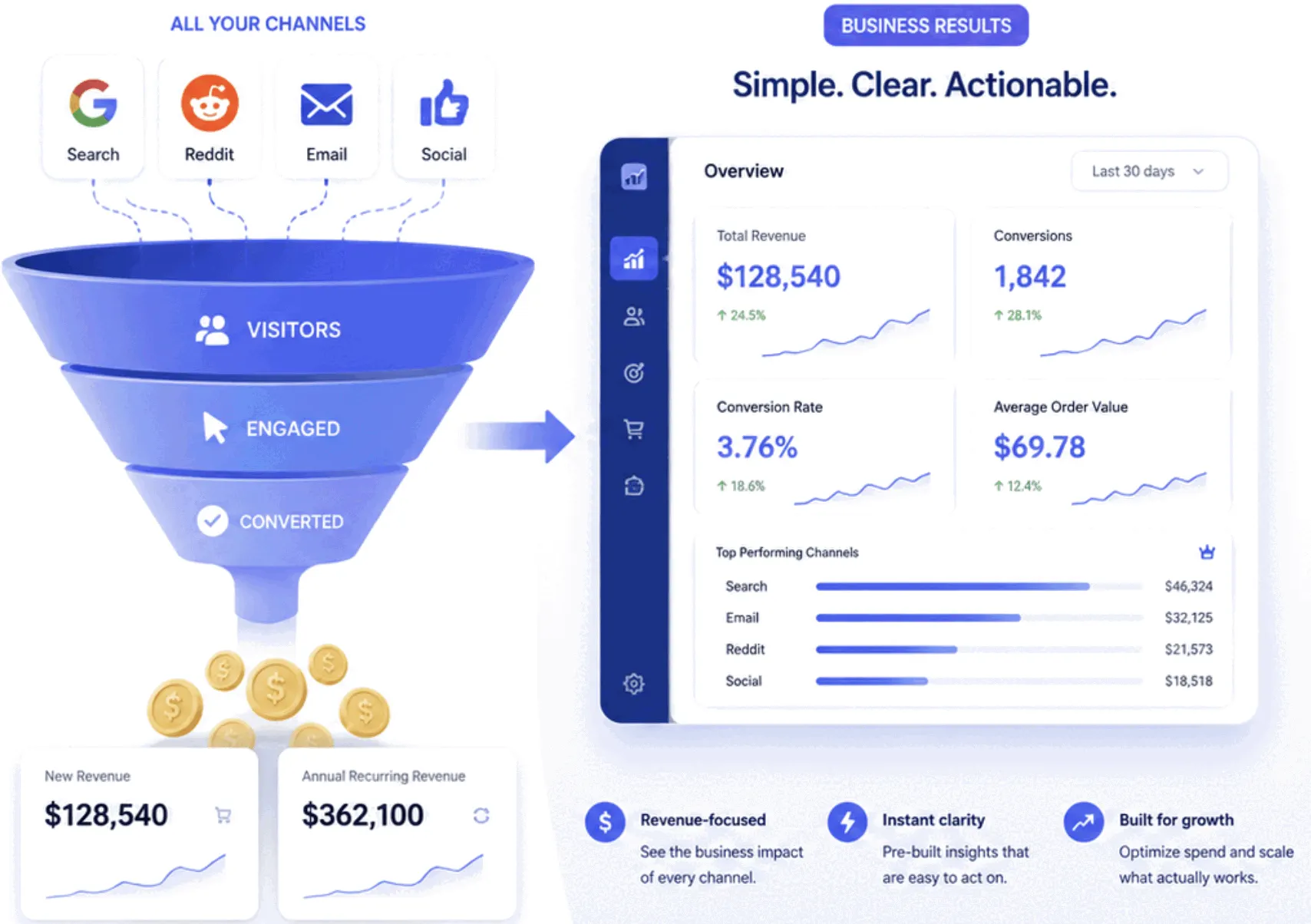
Plausible and Fathom deliberately stop at counting traffic — no recordings, no heatmaps, no view of what happens after a click. Bigdelta keeps their simplicity but goes past that line in both directions: replays and heatmaps on the behavior side, and billing on the money side — link Stripe or PayPal and traffic sources carry revenue, so the sources chart says 'this channel sent $2,100' instead of 'this channel sent 300 visits.' Post-signup user profiles tie the same journey to a person once someone signs up.
The fit is sites that sell something. If nothing on your site takes payment or signup, the revenue join is machinery you won't use — though the free tier makes it a cheap way to get replays and heatmaps alongside the numbers.
How to actually choose
Skip the feature tables and answer two questions. Does your site make money directly — sales, subscriptions, signups worth dollars? And do you run paid ads on Google?
Ads-heavy and Google-centric: GA4, and accept the learning curve as tuition. Data sovereignty as a hard requirement: Matomo, self-hosted. Content site, portfolio, or anything that just needs honest visitor numbers: Plausible or Fathom, whichever prices better at your traffic. A site that sells: a tool that can see the money — Bigdelta is built for exactly that case. And whatever you pick, installing it works the same way — paste the snippet, wait, watch the first visitors arrive.
Running two in parallel for a couple of weeks costs nothing and settles the choice with your own traffic instead of a stranger's listicle — expect their numbers to disagree a little; that's normal.