Exit rate vs bounce rate: what's the difference?
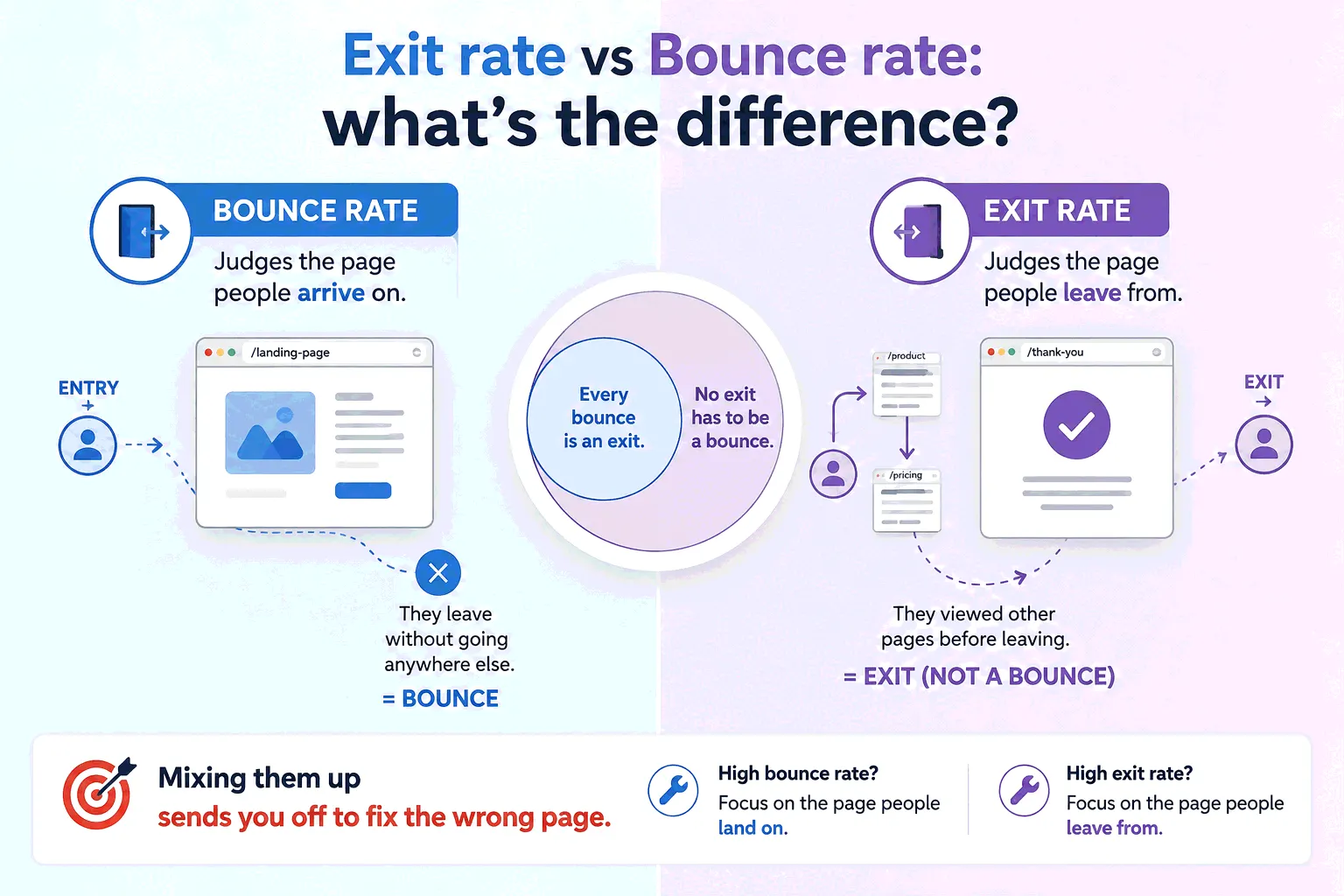
One judges the page people arrive on, the other the page they leave from. Every bounce is an exit, no exit has to be a bounce, and mixing them up sends you off to fix the wrong page.
The two-sentence version
Bounce rate belongs to the page a visit started on: the share of visits that landed there and left without doing anything else. Exit rate belongs to any page a visit ended on: out of everyone who viewed the page, how many were on the last stop of their visit.
That makes them different kinds of web analytics measurement. A bounce describes a whole visit — one page, in and out — so it only ever gets pinned on landing pages. An exit is just the unremarkable fact that every visit ends somewhere. Your checkout confirmation page can have a 0% bounce rate (nobody lands there from outside) and a 95% exit rate (nearly everyone leaves after it), and both numbers are exactly right.
The math, side by side
A pricing page gets 1,000 views this month, and 350 of those views were the last page of their visit: 350 ÷ 1,000 = 35% exit rate.
The two rates divide by different things, which is where most confusion starts. Bounce rate is single-page visits divided by visits that entered on that page. Exit rate is exits divided by all views of that page, wherever it sat in the journey.
Take that same pricing page: 400 visits started there, and 120 of those looked at nothing else — a 30% bounce rate next to the 35% exit rate. The overlap is real (those 120 bounces are also exits), but the remaining 230 exits came from people who browsed around first and finished on pricing. Same page, two numbers, two different stories about it.
Where to find them (GA4 makes you do the division)
If you use GA4, two things moved. Bounce got redefined — it's now any session that doesn't count as engaged, a lower bar than the classic one-page definition, and what's a good bounce rate covers what that does to the number. And exit rate stopped being a built-in metric entirely: GA4 gives you an 'Exits' count per page, but the rate is homework — exits divided by that page's views, in a spreadsheet or a custom exploration. Universal Analytics used to do this for you; GA4 decided engagement metrics mattered more.
Simpler analytics tools mostly kept the classic definitions: bounce as single-page visit, exit rate precomputed per page. As with every metric in this family, compare numbers only within one tool — different tools disagree on the underlying definitions, and bounce is one of the worst offenders.
When a high exit rate is fine
Exit rate has no universal good range, because pages have jobs and some jobs end the visit. An order confirmation, a thank-you page after a form, a contact page once the address is copied — people leaving from there is the system working. Blog posts run high too: someone searched a question, read the answer, closed the tab satisfied. Nothing to fix.
The exits worth attention are the ones that interrupt a job half-done. A product page that should hand visitors to the cart, a signup form's first step, page two of a three-step checkout — when those are where visits end, each exit is a small verdict. The useful move is to stop scanning sitewide exit rates and instead line up only the pages that are supposed to lead somewhere, then ask which of them leaks the most.
Using exit rate to find the leak
That framing turns exit rate into a targeting tool. List the steps of your funnel in order, put each page's exit rate next to it, and the step where the number jumps is where the journey dies. Bounce rate can't see this — mid-funnel pages barely have landings, so their bounce rate is noise built on a handful of visits.
What exit rate won't tell you is why. The page with the 60% mid-funnel exit might have a broken button, a surprise shipping cost, or a form that asks for a phone number nobody wants to give. The number picks the page; watching a few session recordings of people who left from it usually names the problem within the hour.
The practical takeaway
Bounce rate asks 'did the landing page hold anyone?' and exit rate asks 'is this where journeys end?'. Use bounce rate on the pages that receive traffic, exit rate on the pages that are supposed to pass it along, and neither as a sitewide verdict. A high number on a page whose job is done is a shrug; the same number one step before the goal is the most specific to-do list your analytics will ever hand you.