What's a good amount of traffic for a website?
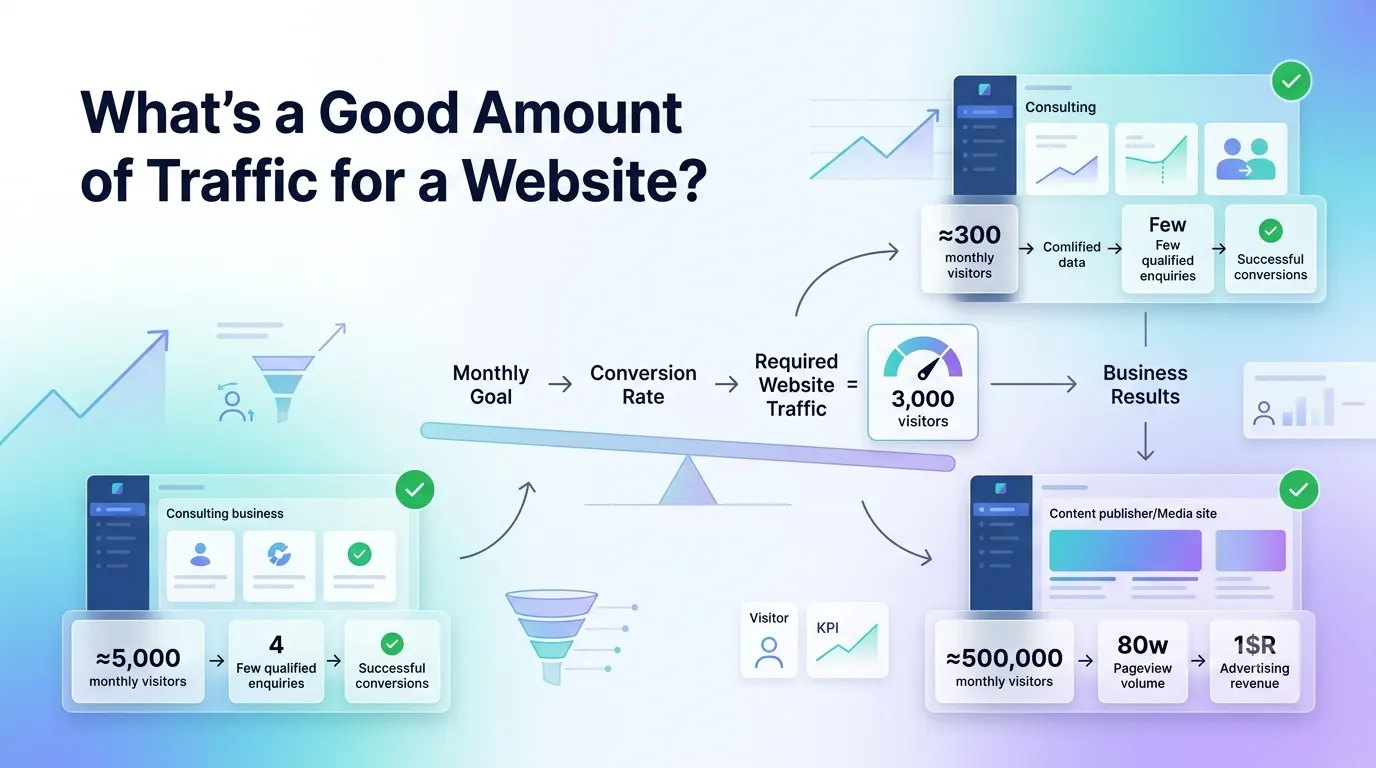
A consultancy can thrive on 300 visits a month while a content site starves on 50,000. The benchmark worth having comes from your own numbers: monthly goal divided by conversion rate.
Why there's no universal number
Traffic benchmarks fail because sites have different jobs. A freelance consultant's site exists to produce two inquiries a month; a content site needs hundreds of thousands of pageviews before ad revenue pays anyone; a SaaS landing page sits in between. Those three can all be succeeding at 300, half a million and 5,000 monthly visits respectively — a single 'good' number would misdiagnose them all.
Published averages mislead in the other direction. Web traffic is winner-take-most: a small number of huge sites drag every average up, while a typical small-business site sees somewhere between a few hundred and a few thousand visits a month. Comparing a six-month-old site to an industry average is comparing yourself to a distribution you're not in yet.
Compute your own benchmark
You want 20 signups a month and about 2% of visitors sign up: 20 ÷ 0.02 = 1,000 visitors a month is 'good' — for you.
The useful benchmark is derived from what the site is for. Decide the monthly outcome — signups, inquiries, orders — and divide by the share of visitors who take that action. Visitor-to-signup conversion rates commonly land between 1% and 5%, ecommerce checkout between 1% and 3%; once you've measured your own, it replaces the range.
The formula also exposes the two ways to hit any goal: more traffic, or better conversion. Doubling a 2% conversion rate is frequently cheaper than doubling traffic — which is why 'is my traffic good' often dissolves into 'is my page doing its job', a question with its own checklist.
What a new website should expect
The first months of a new site produce numbers that feel like failure and are just the default: single-digit daily visitors, several of them you. A site nobody has linked to has no route for strangers to arrive by — search engines take months to trust a new domain, and until then traffic is whatever you personally distribute through posts, launches and conversations.
Rough expectations for a site being actively worked on: months one to three, dozens to a few hundred visits a month, mostly from your own sharing; months three to twelve, the first steady search trickle if content keeps shipping; year two onward, compounding, as every post and backlink raises the floor.
The numbers that matter more than the total
Past the vanity threshold, three cuts say more than volume. Source mix: traffic arriving via search and referrals compounds, while traffic that only arrives when you post is rented. Returning visitors: strangers who come back chose to, and a stable core of returners is worth more than a larger churn of one-time visits. And conversion: 500 visitors with the problem you solve outperform 50,000 from an unrelated viral hit — the bounce rate usually tells that story first.
This is also the answer to traffic envy. A competitor's bigger number — even when the estimate is right — says nothing about whether their traffic does anything.
The practical takeaway
A good amount of traffic is your monthly goal divided by your conversion rate — computed once, re-derived as both inputs improve. Below the number, work on distribution; above it, work on conversion. And measure with a real counter rather than instinct: a goal-derived benchmark only works when the traffic figure in front of you is one you can trust.