How accurate are website traffic checkers?
Screaming Frog compared estimators against real analytics on 25 sites: Semrush ran about 42% low, Ahrefs 36%, and SimilarWeb averaged closest with the wildest variance. Where the numbers come from, and when to trust them.
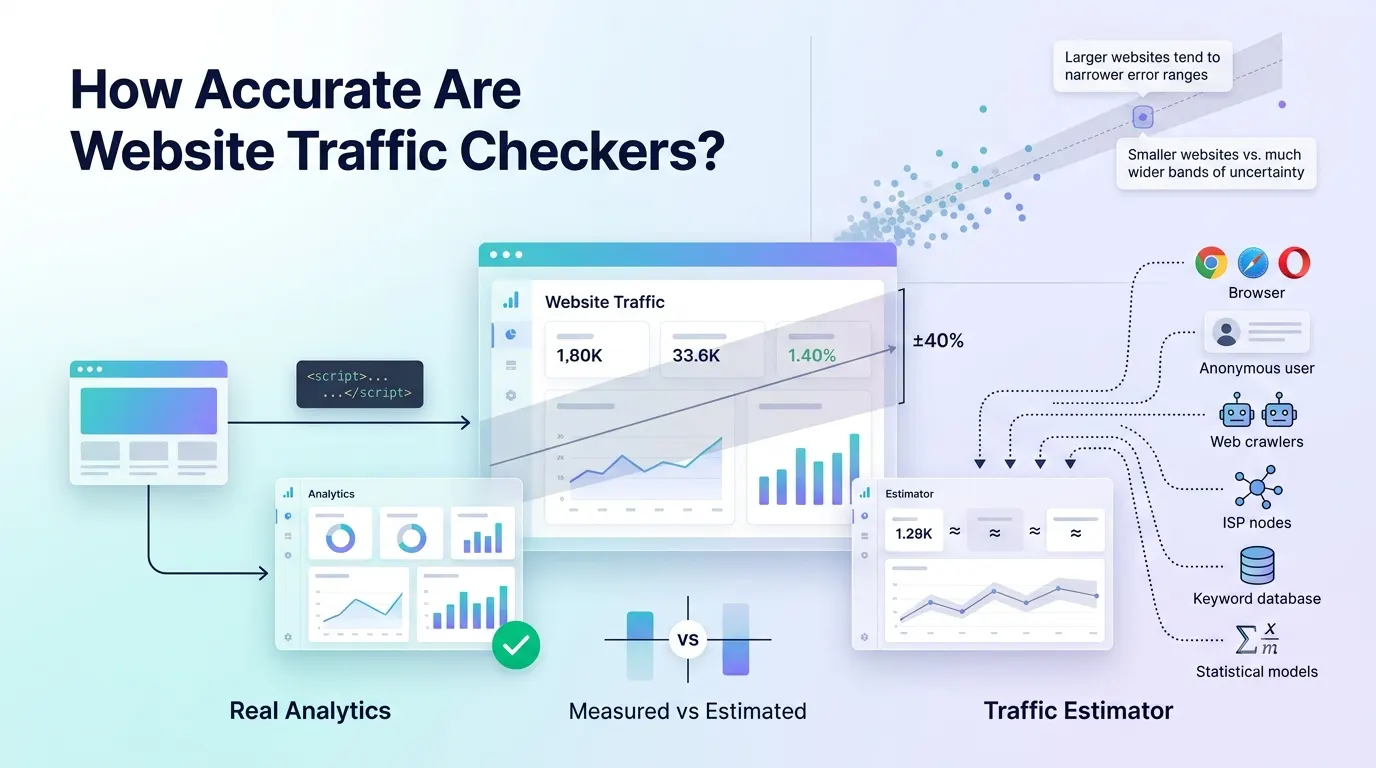
Estimates, not counts
A traffic checker has never seen the site it's describing. Only a snippet on the site itself counts visits; everything SimilarWeb, Ahrefs or Semrush shows about someone else's domain is a model — built from clickstream panels (browser extensions and apps that report where their users go), ISP partnerships, crawl data and keyword databases, extrapolated up to the whole internet.
There's no other way such a product could exist. But it means every number they show carries modeling error, and the size of that error is the difference between useful competitor intel and fiction with a chart.
How far off are they?
The best public test is Screaming Frog's: 25 sites where they had the real Google Analytics data, compared against the estimators' figures. SimilarWeb came closest on average — about 1% off — but the average hides swings of 50% and more in both directions on individual sites. Ahrefs underestimated real traffic by roughly 36% on average; Semrush by about 42%.
Later comparisons by Collaborator and Promodo found the same shape: large tool-to-tool discrepancies on the same domains, with no single tool reliably closest. Two checkers can disagree about one site by a factor of two while both present the number with the same confident interface.
Why small sites get the worst numbers
Panel-based estimation is a sampling exercise, and samples are cruel to small populations. A site with five million monthly visits leaves footprints in any clickstream panel; a site with 5,000 might be represented by a handful of panel members, and the extrapolation multiplies whatever noise they contribute. Screaming Frog found accuracy degraded sharply below roughly 10,000 visits a month — many small sites show no estimate at all, or one wrong by multiples.
There's an irony in who gets hurt: the person reaching for a free checker to see their own numbers is usually running exactly the kind of small site the checkers are worst at. The tool most likely to be consulted is the least likely to be right.
What estimators are genuinely good for
Relative readings survive the error better than absolute ones. Whether competitor A is roughly ten times competitor B, whether a site grew or shrank over six months, which countries and channels dominate its traffic — comparisons made inside one tool hold up reasonably well, though the small-site caveat still applies to both sides of any comparison.
So use them the way market analysts do: for market maps, competitor direction and sanity checks. Never to settle what your own traffic is, and never to grade a small site.
For your own site, don't estimate
The strange habit this search reveals: people checking their own site's traffic in SimilarWeb. For a domain you control, the accurate method is free and takes minutes — an analytics snippet counting actual visits. Bigdelta, GA4 or any lightweight counter gives exact numbers where the best estimator is ±40%; the full setup walkthrough covers the options. An estimator pointed at your own site answers only one question: what your competitors think your traffic is.
The practical takeaway
Treat every traffic-checker number as an order of magnitude with error bars: closest on big sites, unreliable below about 10,000 visits a month, and 30–40% low on average in two of the three big tools. Compare competitors inside a single tool, read trends rather than levels, and count your own traffic with a snippet — the one method with no model in the middle.