Traffic sources: direct vs. organic vs. referral vs. paid
Four buckets decide where your visitors 'came from' — and the biggest one is a catch-all for traffic the tool couldn't identify. What each source really means, why 'direct' misleads, and why the top source of visits is rarely the top source of revenue.
Traffic by source: visits vs. revenue
The four buckets
Every analytics tool sorts incoming visitors into a handful of channels. It reads two things off each visit — where the click came from (the referrer) and any campaign tags on the link — and drops the visit into the first bucket whose rule matches. The four that cover most traffic:
- Organic — unpaid clicks from a search engine (someone Googled a question and found you). The intent gold standard: they were already looking.
- Direct — the tool couldn't work out where they came from, so it filed them here. In theory 'typed the URL or used a bookmark'; in practice a catch-all (see below).
- Referral — a click from another website's link (a blog post, a partner, a directory) that isn't a search engine or a paid ad.
- Paid — clicks from ads you paid for (Google Ads, Meta, LinkedIn), recognised by the ad-click tags on the URL rather than the referrer.
Why 'direct' isn't the loyalty badge it looks like
Here's the mechanism worth understanding, because it explains most of what looks wrong in a channel report. The tool doesn't identify a source so much as match rules in order: is there a search referrer? An ad tag? A known social domain? A campaign tag? The first rule that fits wins. When nothing fits, the visit is labelled 'direct'. So direct doesn't really mean 'typed it in' — it means 'couldn't tell'. 'Unknown' would be the honest label.
And the tool fails to tell more often than you'd think, because the referrer it relies on goes missing constantly. Links opened from Slack, WhatsApp, Messenger and other apps arrive with no referrer at all; mobile apps and in-app browsers strip it; PDFs and Office documents carry none; a jump from an https page to an http one drops it; and any untagged campaign link never had one to begin with. SparkToro's research found that essentially every visit shared through Slack, Discord, WhatsApp or TikTok gets misfiled as direct. All of it lands in one pile, labelled as if the visitor appeared from nowhere.
A rough gauge: for most sites direct sits somewhere around 15–30% of traffic. Much past 40% and it usually isn't a surge of brand love — it's a measurement gap worth auditing.
Tagging fixes the links you control — and only those
The one lever you fully own is tagging. Put UTM parameters — utm_source, utm_medium, utm_campaign — on every link you place yourself: newsletters, social posts, ads, the link in your bio, PDFs, QR codes, partner swaps. The tags stamp the origin onto the URL so the tool never has to guess, and those visits get their real names back instead of falling into direct. Keep the tags lowercase and consistent, because the tool reads 'Email' and 'email' as two separate channels.
The catch, and it's easy to miss: UTMs only help on links you place. The largest slice of the direct pile — someone pasting your link into a private message, a third-party site that strips the referrer, a click from inside a mobile app — can't be recovered no matter what you tag. Disciplined tagging shrinks the mystery bucket; it never empties it. Tag everything you touch, and treat the rest as permanent fog rather than a number to chase to zero.
The trap: traffic rank ≠ revenue rank
Here's the mistake the channel report invites: ranking sources by visits and pouring budget into the biggest one. The source that sends the most visitors and the source that sends the most revenue are frequently not the same source — a viral referral can dump thousands of curious, low-intent visitors who never buy, while a small paid campaign or a niche newsletter sends a fraction of the traffic and most of the money.
The chart above shows the shape of it with an illustrative split: organic and direct lead on visits, but paid leads on revenue. Read the table by visits alone and you'd pour money into the wrong channel. The only way to see the real ranking is to attach revenue to each source — which is exactly what most analytics tools can't do, because they stop counting at the visit.
How to read sources properly
Judge a channel by outcome, not volume. The same cut of data that ranks sources by visits can rank them by conversion rate and bounce rate — and those tell a truer story. Social traffic reliably converts worse than search or email, often around half the rate, because a mid-scroll click carries less intent than a mid-search one. A channel with modest traffic but a strong conversion rate is usually worth more than a firehose that bounces.
One caveat matters here: a low conversion rate doesn't automatically condemn a channel. Last-click reports credit whichever source showed up last, so a Reddit thread that introduces someone who returns a week later via search and buys hands the whole sale to search — the referral did the work and gets none of the credit. A poor converter is worth investigating before you cut it; it may be the channel doing the introducing.
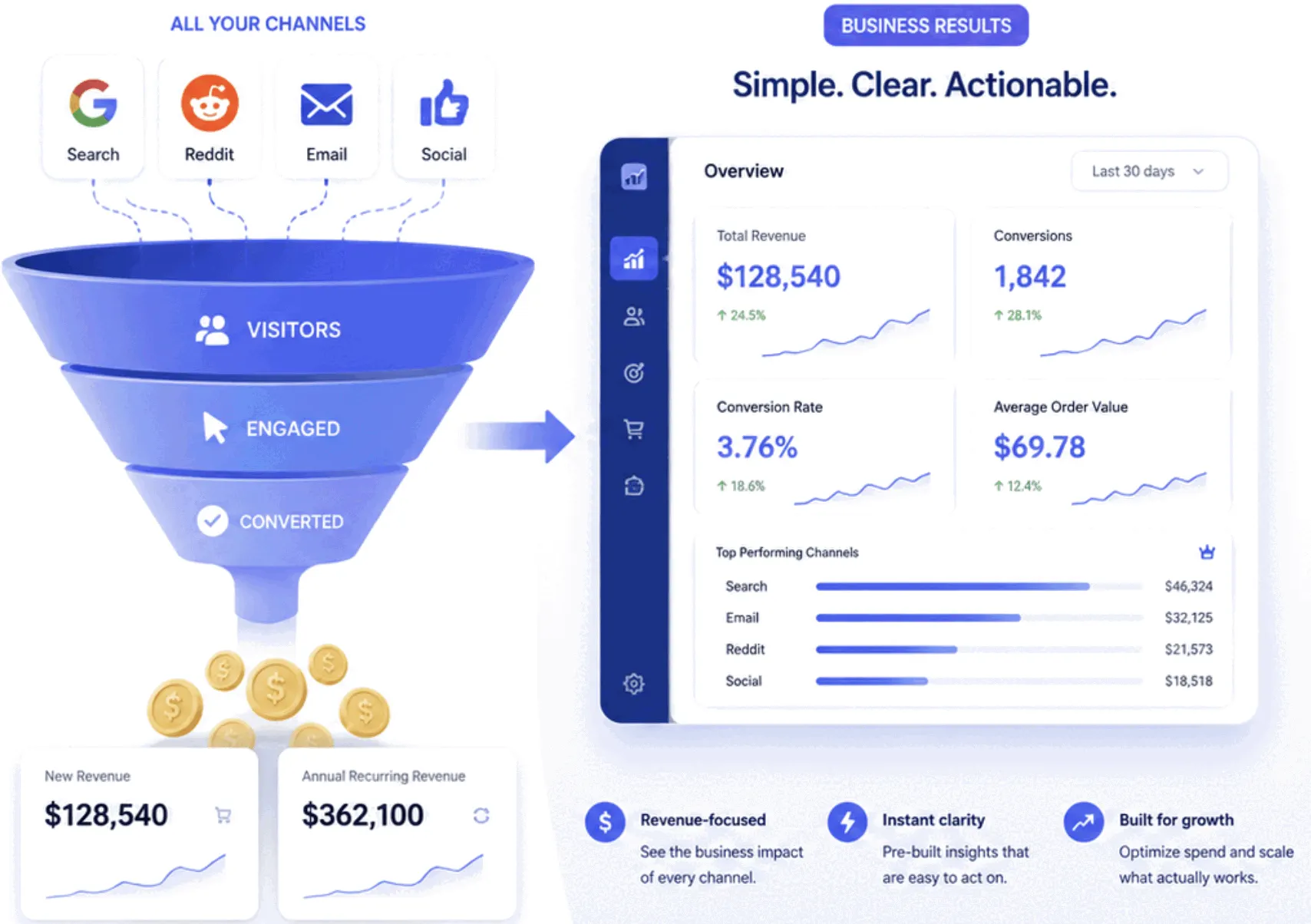
Best of all, rank by revenue per source when you can. 'Reddit sent 1,400 visits and $89, the newsletter sent 90 visits and $2,300' is a different budget conversation than any visit chart, and it's the version of 'where should we spend?' the numbers are actually there to answer. In Bigdelta, source flows through to revenue, so the channel table ends in dollars, not just sessions.
The practical takeaway
Treat the four buckets as a rough first sort. Read a large 'direct' share as a prompt to tag the links you control and check for referrer-stripping, rather than proof of brand strength. Then stop ranking channels by traffic: layer conversion, bounce and, wherever possible, revenue on top — with one eye on the last-click blind spot. The biggest source of visits is the one most likely to be lying about its worth, and the channel that quietly pays the bills is rarely the one at the top of the chart.