Dark traffic: the visitors your analytics can't see
Ad blockers stop the analytics script for roughly a third of the web. Privacy browsers strip referrers and cap cookies. Consent banners never get an answer from half of desktop visitors. And most private shares arrive with no referrer at all, landing in Direct. Your dashboard shows a sample, not the universe.
The short answer
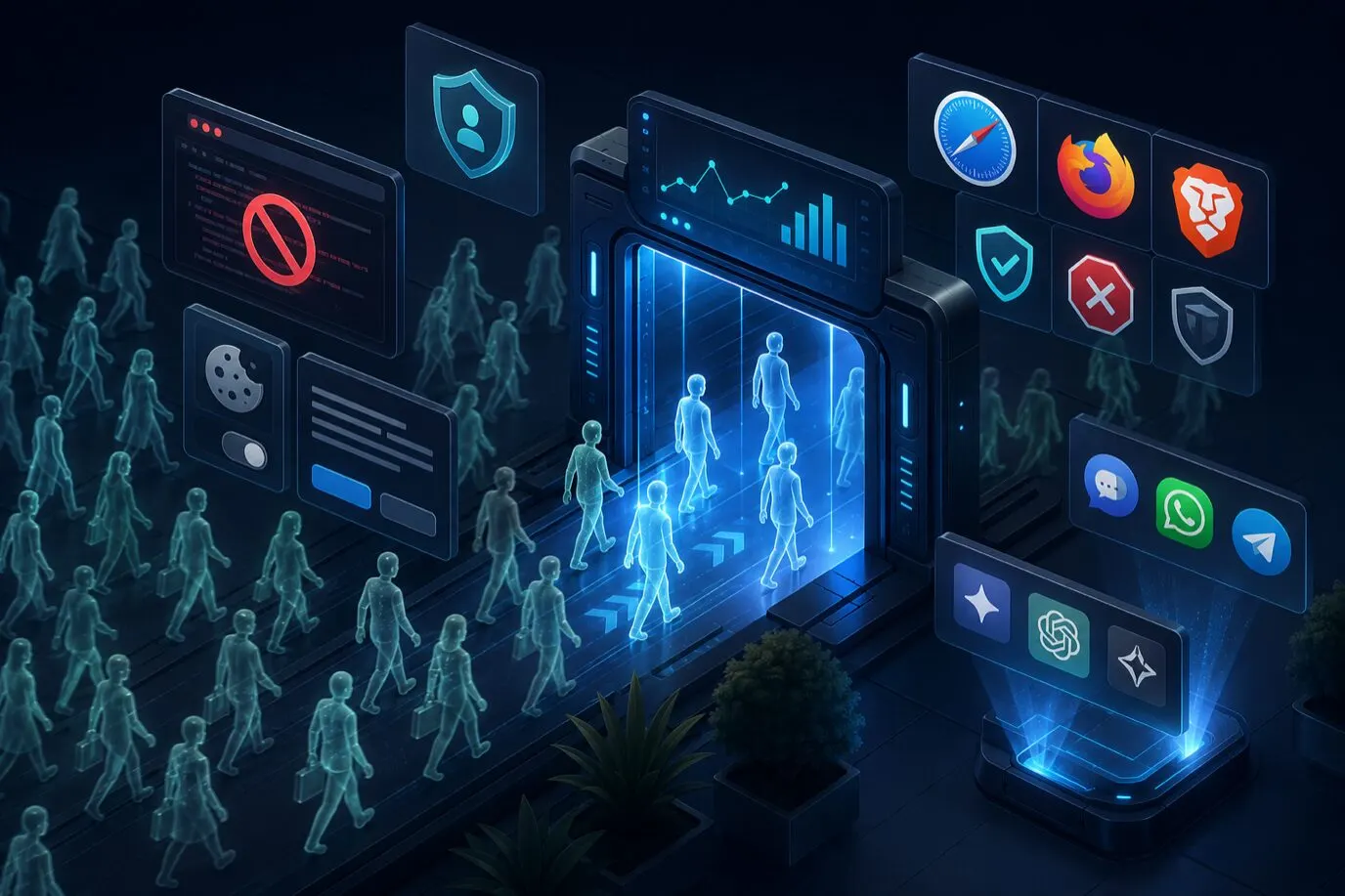
Dark traffic has two meanings that overlap in practice. The classic one: traffic that arrives in your Direct category because the referrer got stripped — apps that drop you on a website, email, messaging apps, Slack, QR codes. The modern one: visitors your analytics tool never sees at all, because blockers, privacy browsers, or consent choices stopped the script from firing. How much of your audience is invisible depends on who reads you and what you measure with: a developer-heavy site behind a consent banner can lose close to half its visitors, a general-interest site on a cookieless tool far less. The undercount isn't a bug; it's structural to how the web works in 2026.
Ad blockers: a third of visitors stop at the gate
About 29.5% of internet users worldwide block ads, as of Q2 2025 — roughly 1.77 billion people. The United States sits at 32.5%. On desktop, 37% of users block ads; on mobile it drops to 15%, partly because fewer ad-blocking tools exist for phones.
The question for analytics is not who blocks ads but what blockers block. Ad blockers target known tracking domains and scripts that match tracking patterns, and Google Analytics sits on every blocklist. Brave, the privacy-focused browser, blocks GA4, Meta Pixel, and most analytics scripts by default — and unlike ad blocker extensions that users must choose to install, Brave's blocking is on from the first launch, so its users are invisible to standard analytics from day one.
The realistic impact spans a wide range. A blog read by developers and security professionals might lose 40–60% of its traffic to blocking; a general-interest site might lose 5–15%. There is one escape route: serving the analytics request from your own domain rather than a known tracking service. When the browser sees the request as first-party, most blockers that target third-party tracking domains don't intercept it.
Privacy browsers: Safari, Firefox, and Brave
Beyond ad blockers, three browsers have built-in privacy features that hide traffic or break attribution — together they carry a fifth or more of typical web traffic.
Safari uses Intelligent Tracking Prevention. It caps JavaScript-set cookies to seven days — or 24 hours if the user arrived with a tracking parameter like gclid or fbclid. For marketing analytics this is brutal: a customer who takes two weeks to convert disappears from the attribution model. And on iOS, every browser — Chrome, Firefox, Edge — runs Safari's engine underneath, so ITP applies to iPhone traffic regardless of which browser icon the user tapped.
Firefox's Enhanced Tracking Protection strips tracking parameters like fbclid and gclid directly from URLs. The analytics script may load, but it sees a clean URL with no campaign information, so conversion attribution fails at the source.
Brave takes the most aggressive approach: it blocks GA4, Meta Pixel, and most analytics scripts by default. Brave users are invisible to most client-side tracking unless the script is served first-party or the site moves to server-side methods.
All three mean traffic simply evaporates from your analytics — not because of an extension the visitor installed, but because the browser itself prevents the tracking script from reporting back.
Consent banners: the signal you never receive
Consent banners create a different kind of invisibility. According to the 2026 Privacy Barometer, 47% of desktop visitors generate no consent signal at all — neither acceptance nor refusal. They never interact with the banner. When visitors do engage, roughly 69% accept on desktop and 76% on mobile, which means about a third of engaged desktop users actively reject tracking.
The real problem isn't that users refuse consent at high rates; it's that nearly half never engage with the banner at all. Someone landing on your homepage, skimming a product page, and bouncing before answering the banner generates no signal, so a consent-gated tool must treat them as non-consenting. And many implementations collect preferences correctly but never actually transmit them to the analytics backend — dashboards stay green while data is silently lost.
One important scoping note: this whole category of loss applies to cookie-based tools that need the banner in the first place. A cookieless analytics script that sets no identifier dodges the consent gap — it still loses the adblocked visitors above, but not the decliners and the never-engaged.
Dark social and the untagged Direct bucket
Dark social is traffic that arrives without a referrer header because it came through a private channel. Messenger, email, Slack, WhatsApp, Discord, SMS, QR codes — most content sharing happens in these channels, but when someone clicks through, the analytics tool has no referrer string to identify the source and defaults to Direct. Your dashboard shows Direct traffic as mysteriously high; you assume people are typing your domain into the address bar, when actually they're coming from private messages.
AI platforms are accelerating this. ChatGPT, Perplexity, Gemini, and Claude don't consistently pass referrer information when users click through from chat interfaces. The measurement is young, but the direction is clear enough to call AI referrals the fastest-growing source of dark traffic in 2026: users ask an AI to summarize or recommend something, click a link, and land on your site unattributed.
The classic meaning of dark traffic is recoverable: use UTM parameters on every link you control. If your newsletter has a link, tag it. If an influencer shares your content, hand them a URL with parameters. QR codes get unique tags. This way the source survives the jump even when the referrer doesn't. AI traffic is less recoverable — you can't control what a chat interface passes to your server — but UTM discipline still catches everything you distribute yourself.
What dark traffic does to benchmarks
None of this means your analytics dashboard is broken. It means the number you see is a sample of your actual audience, not the population. The mechanisms overlap — a Brave user is already inside the ad-blocking statistic, and consent losses only apply to tools that ask — so you can't add the percentages up. But even conservatively, a site reporting 10,000 monthly visitors on a cookie-based tool plausibly had 13,000–15,000 real ones. You're measuring the unblocked, consenting slice that made it through.
This makes comparing your numbers to published benchmarks shakier than it looks. A benchmark never discloses how much of its own audience was blocked, how Safari-heavy its readers were, or whether a consent banner was in the way. You're comparing your visible traffic to someone else's visible traffic without knowing how much each of you lost.
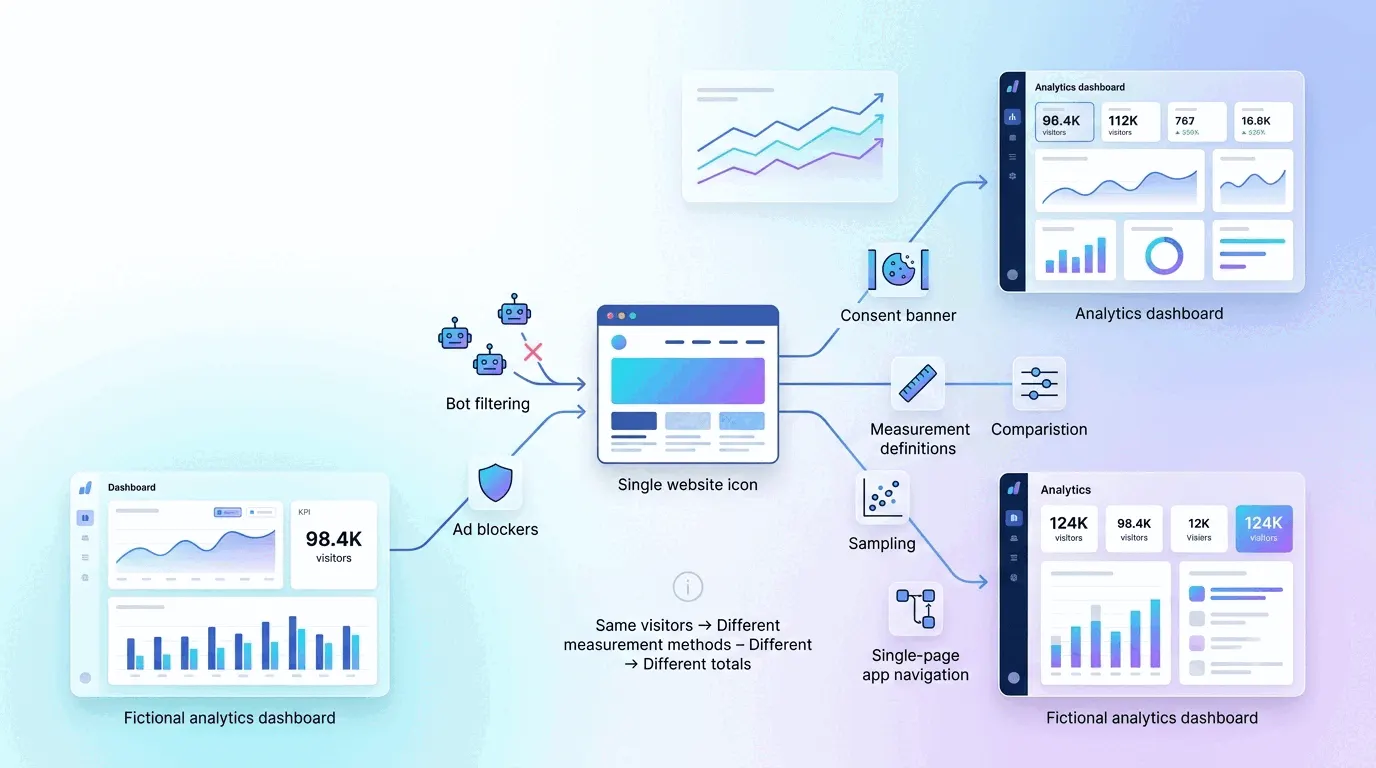
It also explains part of why two tools on the same site report different numbers: each tool sits behind a different subset of these filters, so each one sees a different slice of the same audience.
What you can do about it
You can't eliminate dark traffic — it's structural — but you can shrink each slice. For ad blockers and privacy browsers, the levers are serving analytics first-party or moving measurement server-side; both make the request look like part of your site instead of a known tracker. For consent loss, the choices are improving banner engagement, implementing consent-mode modeling and verifying the signal actually arrives, or using a cookieless tool that doesn't need the banner. For dark social, tag relentlessly: every link you put into an email, a DM, a QR code, or a bio is a link that can carry its own source label.
The honest summary: the traffic you measure is lower than the traffic you have. The number still works for trends and decisions inside one tool — but it's not the truth about your audience, and knowing the gap exists is what keeps you from making bad calls with incomplete data.