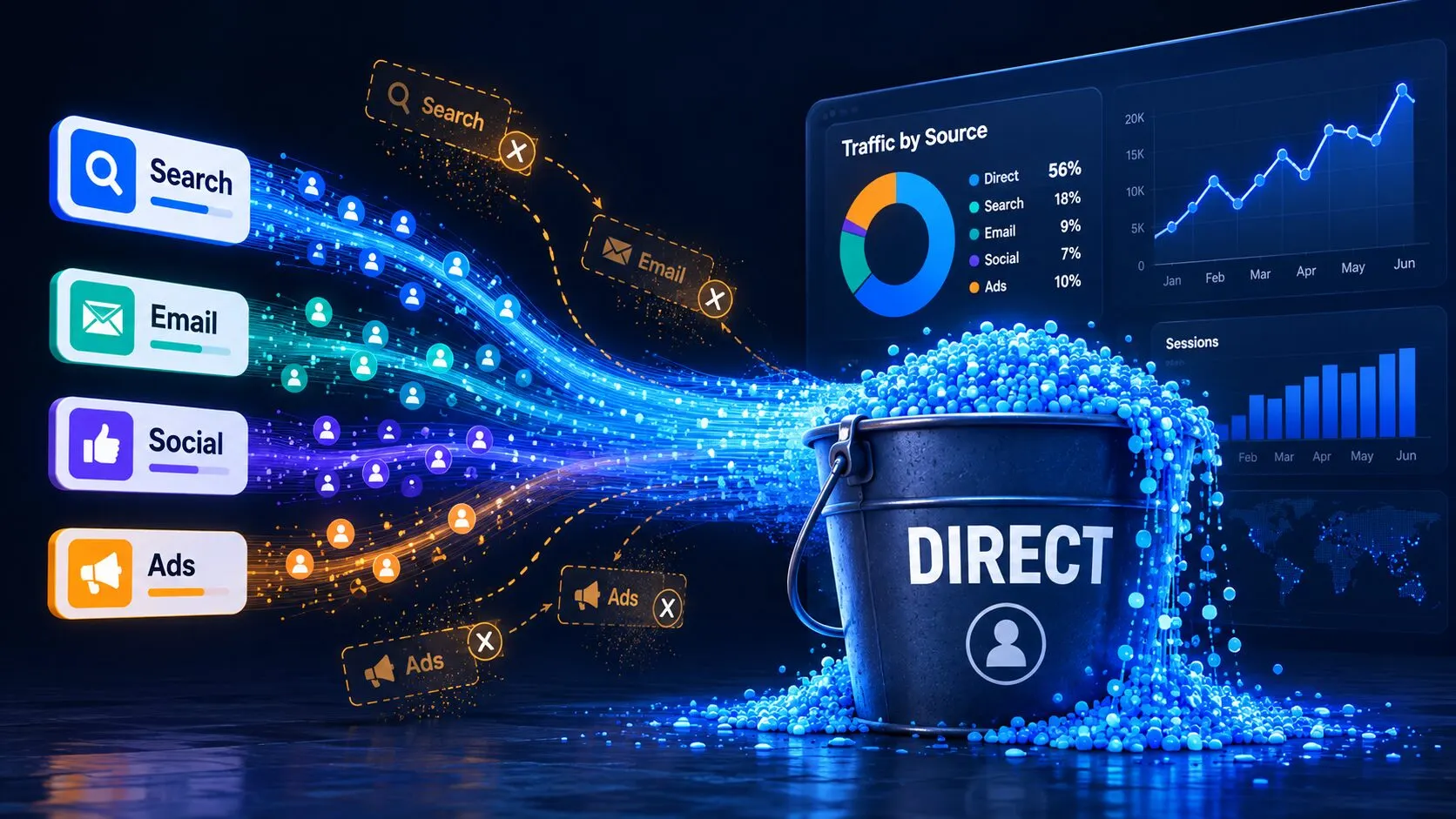
Traffic source mix: how much of your traffic should be organic?
The famous claim that organic drives 53% of traffic is seven years old and undocumented. What the 2026 sources that disclose their methodology actually report, why they disagree about direct by a factor of two, and the three readings of your own mix that matter.
What the disclosed sources report
Two large studies published in 2026 describe the channel mix, and they disagree so instructively that the disagreement is the lesson.
Semrush's traffic channel mix study (April 2026), built on clickstream-panel data covering 50,000 sites, puts direct at about 65 percent of visits, organic search at 16, referral at 10, and everything else in single digits, with AI-assistant referrals at 0.14 percent. Its year-over-year finding is the striking part: organic search traffic declined in 13 of the 17 industries it tracks, with drops around 25 to 30 percent in healthcare, banking and education, while apparel and beauty grew.
Contentsquare's 2026 Digital Experience Benchmark, measured by analytics tags on 6,500 mostly enterprise sites across 99 billion sessions, reports direct at 29 percent of visits, paid search at 25, and paid channels combined at roughly 42 percent, with AI referrals at 0.2 percent of traffic but growing more than sixfold year over year.
So the web's biggest disclosed panel says direct is two-thirds of traffic, and the biggest disclosed tag dataset says it is under a third. Both measured honestly. A panel watches devices and classifies app opens and stripped referrers as direct aggressively; tags on enterprise brand sites see heavy paid spend and cleaner attribution. "The average mix" depends entirely on who is measuring and how, which is the first reason no percentage deserves to be your target.
Two narrower sources complete the picture. Ahrefs' organic traffic benchmarks (June 2026), drawn from Search Console data across 344,956 sites, finds organic traffic distributed as a power law, driven by site authority and size rather than industry, another argument against industry lookup tables. And SparkToro's zero-click research reports that 68 percent of US Google searches now end without a click to any website, up from about 45 percent a decade ago. Whatever share organic holds in your mix, the pressure on it is structural.
Why "organic share" is a definition, not a measurement
Before comparing your mix to anything, know what made it. Channel shares come out of grouping rules, and GA4's default rules are choices, not facts: unmatched source/medium combinations land in Unassigned, while visits whose referrer was stripped, by an app, a messenger, an email client, land in Direct. That second mechanism, dark traffic, quietly inflates direct on every site, and a "growing direct share" is more often measurement decay than brand strength. What is direct traffic unpacks it properly.
AI referrals complicate it further. Clicks from ChatGPT, Perplexity and their peers have no default channel of their own and arrive as referral, or as direct when the referrer is stripped. On current disclosed measurements they are still small, between 0.1 and 0.2 percent of visits in both studies above, and Similarweb's industry tracking counts about 770 million AI referral visits a month globally, roughly doubling year over year. A small base, the fastest growth rate in every report, and worth its own labelled segment before the default grouping smears it.
Reading your own mix
There is no correct percentage, because the mix reflects the business. A subscription product with word of mouth runs high direct. A store buying Meta and Google ads runs high paid, Contentsquare's enterprise retail data has paid at four visits in ten. A content site lives and dies on organic. Comparing any of them to an average of all of them answers nothing.
Three readings of your own numbers do the work an average cannot. Watch share movement against your own history: one channel's slice collapsing, or direct creeping upward for no campaign reason, is the actionable signal, and why did my traffic drop covers the diagnosis when it moves sharply. Watch concentration: a site drawing 70 or 80 percent of its visits from one channel, usually Google organic, is carrying real risk in a market where organic declined in most industries last year and most searches end clickless. And watch the direction the disclosed data agrees on: paid share rising, organic under pressure, AI referrals small but compounding. A mix that is diversifying beats a mix that matches any published number.